The successful recovery of the Long March 10B first stage marked an important step towards reusable orbital launch systems.
After launching from the Hainan Commercial Space Launch Site on July 10, 2026, the rocket placed its payload into orbit before the first stage returned to a sea-based recovery platform. Instead of using conventional landing legs, the booster was captured by a net system installed on the offshore platform.
The recovery system attracted much of the attention. But reusable launch vehicles are not created by recovery technology alone.
Behind every launch stands an extensive manufacturing infrastructure capable of producing large tank domes, cylindrical sections, reinforced panels and assembled airframe structures with aerospace-grade accuracy. These components must not only be lightweight and precise. They must also withstand repeated mechanical and thermal loads while being manufactured efficiently enough for future batch production.
This is where advanced machining, welding and automated assembly technologies become essential.
Reusability begins in production
Recovering a rocket stage is one part of the challenge. Manufacturing structures that can safely support multiple flight cycles is another.
Large reusable launch vehicles require components with:
- Precisely controlled wall thicknesses
- High-strength and fatigue-resistant joints
- Consistent structural geometry
- Low component weight
- Reproducible quality across production batches
- Efficient and traceable manufacturing processes
Traditional manufacturing methods often distribute these operations across multiple machines, fixtures and workstations. Each additional transfer creates new setup requirements, longer production times and further opportunities for dimensional deviation.
TOPNC has spent 19 years developing manufacturing systems intended to connect these processes. Founded in 2007, the company’s aerospace equipment portfolio now covers precision milling, friction stir welding, automated drilling and riveting, and the assembly of large aerospace structures.
The result is an equipment matrix designed to support the complete production chain for large-diameter launch vehicle components.
Vertical dual-five-axis mirror milling
Large rocket tank domes combine curved geometries with thin walls and substantial component dimensions. Removing too much material can compromise structural integrity. Removing too little adds unnecessary mass.
TOPNC’s vertical dual-five-axis mirror milling systems machine both sides of a thin-walled component in a coordinated process. While one machining head removes material, the opposing system supports or measures the component from the reverse side.
According to TOPNC’s supplied project data, the technology can process tank domes with diameters of approximately five metres while maintaining a wall-thickness tolerance of ±0.1 millimetres.
TOPNC’s official listing documentation also identifies the company as the developer of China’s first five-metre vertical dual-five-axis mirror milling machine. The system enabled the mechanical machining of an integral five-metre tank dome and replaced processes traditionally associated with chemical milling.
For launch vehicle manufacturing, this provides several advantages:
- More consistent wall thicknesses
- Reduced component weight
- Mechanical rather than chemical material removal
- Better process monitoring
- Greater suitability for repeatable batch production
Precision at this scale is not simply a dimensional requirement. Every kilogram removed from the structure can contribute to payload capacity or operational efficiency.
Horizontal five-axis machining for reinforced panels
Grid-stiffened panels are widely used in aerospace structures because they combine relatively low weight with high structural rigidity.
Their machining is challenging, however. Large dimensions, thin base walls and complex reinforcement patterns require stable workholding and accurate tool positioning across the entire component.
TOPNC’s large horizontal five-axis flipping plate milling production line is designed to machine these structures from different orientations without repeatedly transferring them between separate machines.
Based on TOPNC’s project figures, the production concept can increase machining efficiency by a factor of five while reducing associated manufacturing costs by approximately 50 percent.
The benefit extends beyond a shorter machining cycle. Integrated handling and repositioning can also reduce:
- Repeated clamping operations
- Internal component transport
- Alignment errors between operations
- Work-in-progress inventory
- Dependence on multiple standalone machines
For future launch vehicle programmes, such productivity improvements are central to moving from individual project production towards repeatable industrial output.
Heavy-duty friction stir welding
Large rocket tanks are commonly manufactured from lightweight metallic structures that must be joined with high precision and minimal distortion.
Friction stir welding creates a solid-state joint. A rotating tool generates frictional heat and plasticises the material without melting it completely. The softened material is mechanically stirred and consolidated into a continuous joint.
This process is particularly relevant for large aluminium-alloy aerospace structures, where conventional fusion welding can introduce greater heat-related distortion or changes in the material structure.
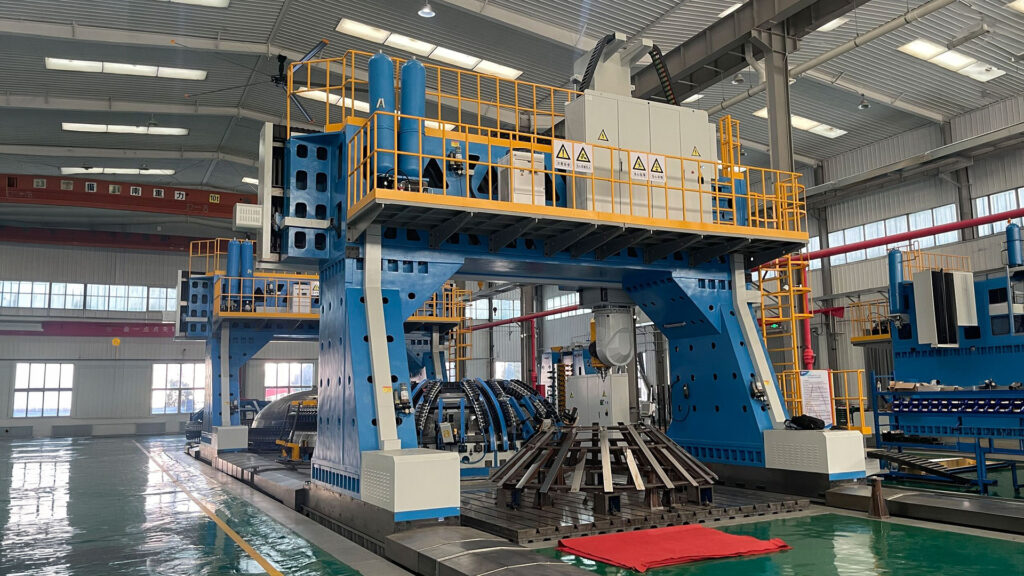
TOPNC’s heavy-duty friction stir welding systems combine welding, positioning, fixturing and machine control within a coordinated five-axis platform. The company’s listing documents describe its system as China’s first friction stir welding machine tool developed for rocket tank production.
According to TOPNC’s supplied technical data, the resulting joints can achieve:
- Joint strength exceeding 90 percent of the base material
- Fatigue life three to five times greater than comparable fusion-welded joints
- Fully automated processing of large curved structures
- Continuous monitoring of pressure, movement and welding parameters
These characteristics become increasingly important when an airframe is expected to experience multiple launch, re-entry and recovery cycles.
A reusable vehicle does not merely need strong joints. It needs predictable joints whose quality can be reproduced and documented throughout the production series.
Automated drilling and riveting
The final assembly of large cylindrical rocket structures can involve a substantial number of holes and mechanical fasteners.
Manual drilling and riveting are labour-intensive and depend heavily on individual operator performance. Variations in hole position, countersink depth or fastener installation can affect both structural quality and the efficiency of downstream assembly.
TOPNC’s automated drilling and riveting equipment combines component positioning, measurement, drilling, countersinking and fastening within an integrated production process. Its aerospace portfolio specifically includes automated drilling and riveting equipment for large rocket and aircraft structures.
According to the supplied TOPNC performance data, the automated process can operate up to ten times faster than manual riveting while delivering consistent aviation-grade results.
Automation also supports:
- Repeatable hole quality
- Precise fastener positioning
- Digital process documentation
- Reduced manual rework
- Stable quality across multiple production shifts
For reusable structures, this consistency supports both initial manufacturing quality and the extended service life expected from the completed airframe.
More than individual machines
No single machine produces a reusable launch vehicle.
The real value lies in connecting machining, welding, measurement, handling and assembly into one coordinated manufacturing system.
TOPNC therefore approaches large-scale aerospace production through a combination of:
Equipment + Process + Service
This can include individual machine tools, process development, production planning, line integration, commissioning, operator training and continued technical support.
The objective is not simply to deliver equipment. It is to establish a stable manufacturing process capable of producing qualified components repeatedly, efficiently and at industrial scale.
The manufacturing era of reusable launch vehicles
The successful recovery of the Long March 10B demonstrates that reusable launch technology is progressing rapidly. The next challenge is to convert individual technical achievements into reliable operational systems and scalable production.
That transition will depend on more than engines, guidance systems and recovery platforms.
It will also depend on the machines that produce the tank domes, mill the reinforced panels, weld the cylindrical sections and assemble the completed airframe.
Recovery may be the moment the world sees.
Manufacturing is what makes the next flight possible.